 |
[Digital image]. (n.d.). Retrieved from
http://www.goodreads.com/book/show/
16285053-that-is-not-a-good-idea
|
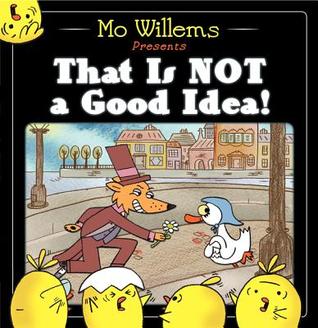
A fox trying to coax a goose into his dinner gets the surprise of his life and so does the reader.
APA Reference of Book:
Willems, M. (2013). That is not a good idea! New York, NY:
Balzer Bray.
Professional Review:
Wernick, M. (2013, February 25). [Review of the book That's not a good idea! by, Mo Willems].
Retrieved from http://www.publishersweekly.com/978-0-06-220309-0
Library Uses:
Due to the capitalization of words to be emphasized, this would be an excellent book to help young readers with intonation and expression. It's also a fantastic example of a book that lends itself well to dramatization. Students can be assigned one of the characters: the fox, the goose, or a gosling. Then, they act-out the story. This type of retelling helps students to learn to visualize the sequence and details in the story. In addition, providing a basket with puppets for the characters and the book would encourage students to re-read the book and then use the puppets to retell the story.
Impressions:
Willems has once again used a simple story line and precious characters to entertain the reader. Through the illustrations and life experiences, the reader begins to draw conclusions only to be pleasantly surprised at the end. Although there are few words on the page which might indicate the intended audience for this book is beginner readers, older readers will be delighted to travel on this path with the fox, the goose, and her goslings.

No comments:
Post a Comment