Saturday, June 18, 2016

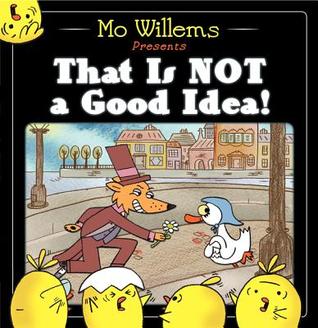
Module 2: That's NOT a Good Idea!


[Digital image]. (n.d.). Retrieved from 
http://www.goodreads.com/book/show/
16285053-that-is-not-a-good-idea
Book Summary:
A fox trying to coax a goose into his dinner gets the surprise of his life and so does the reader.

APA Reference of Book:
Willems, M. (2013). That is not a good idea! New York, NY: 
      Balzer Bray.

Professional Review:

Willems, whose Goldilocks and the Three Dinosaurs also operated on a balance of threat and humor, models this suspenseful picture book after a silent movie. The sequence concerns a dastardly villain, played by a smirking fox in a top hat, and an ingenue, 
played by a coy duck in a blue headscarf. The fox invites the sweet-looking duck “for a stroll.” When she agrees, he asks, “Would you care to continue our walk into the deep, dark woods?” “Sounds fun!” she answers. Each time the duck accepts the fox’s invitations, an increasingly alarmed audience of six yellow peeps pops up to shout some version of the title: “That is not a good idea!” This being a Willems vehicle, a sudden twist reveals which character the peeps have been addressing all along. Cinematic conventions, like neatly framed white-on-black intertitles and gauzy iris-eye close-ups of the eyelash-batting heroine, join allusions to classics like “Henny Penny,” Rosie’s Walk, and perhaps even Mighty Mouse. Trust Willems to blend silents, animation, and comics for a wickedly droll poultry-in-peril yarn. Ages 4–8. Agent: Marcia Wernick, Wernick & Pratt. (Apr.)

Wernick, M. (2013, February 25). [Review of the book That's not a good idea! by, Mo Willems].   
       Retrieved from http://www.publishersweekly.com/978-0-06-220309-0

Library Uses:
Due to the capitalization of words to be emphasized, this would be an excellent book to help young readers with intonation and expression.  It's also a fantastic example of a book that lends itself well to dramatization.  Students can be assigned one of the characters: the fox, the goose, or a gosling.  Then, they act-out the story.  This type of retelling helps students to learn to visualize the sequence and details in the story.  In addition, providing a basket with  puppets for the characters and the book would encourage students to re-read the book and then use the puppets to retell the story.

Impressions:
Willems has once again used a simple story line and precious characters to entertain the reader.  Through the illustrations and life experiences, the reader begins to draw conclusions only to be pleasantly surprised at the end.  Although there are few words on the page which might indicate the intended audience for this book is beginner readers, older readers will be delighted to travel on this path with the fox, the goose, and her goslings.


Tuesday, June 7, 2016

Module 1: Miss Malarky Leaves No Reader Behind


[Digital image]. (n.d.). 
Retrieved from https://
books.google.com/books/
about/Miss_Malarkey_Leaves
      _No_Reader_Behind.html
?id=SBuF8efp1iEC&source=
kp_cover&hl=en

Book Summary:
It's the beginning of the school year and the librarian, Miss Malarkey, decides the school will read 1000 books through the Everybody Reads in America Program this school year.  The main character tells about this adventure through a first person recounting.  He is resistant to all Miss Malarkey's efforts to find him the perfect book.  By the end of the year, Miss Malarkey knows him so well that she is able to find him a book that keeps him up all night reading.

APA Reference of Book:

Finchler, J. & O'Malley, K. (2006). Miss Malarkey leaves no 
      reader behind. New York, NY: Walker Childrens.


Impressions:
This book outlines the role of a librarian perfectly.  It's written from a boy's perspective with a believable plot.  Reluctant readers will relate to this story. It's written for kindergarten through third grade but the older elementary students will relate more so than the beginning readers. Including speech bubbles for the students allows the reader to incorporate some voices to make the reading interesting. They also serve as examples of questions that student may have and helps the reader explore his feelings about what he likes to read. Not to mention, there's just enough humor in the words, as well as, the pictures to make it fun.

Professional Review:

Miss Malarkey, school librarian, has set a goal to have the school read 1,000 books before the end of the school year, and to find a book for each and every student to love. The principal will dye his hair purple and sleep on the roof if they succeed, so the effort is worth it, even when it means getting a crew of video-game aficionados to stick their nose in a book, including the narrator: “I hate reading. . . . I like video games, and so do my friends.” It’s not that he is predisposed to disliking books. He tries the scary books and the joke books and the adventure books Miss Malarkey gives him, but they are as sand to his eyes. He’s just honest. But Miss Malarkey is industrious and full of ideas—amply depicted by O’Malley’s warmly emotive artwork, which videophiles will relate to. She finally brings home the bacon with a title that is the narrator’s to know and readers to find out (though Finchler lends a hand with solid lists of titles, including one about finding books to love). (Picture book. 5-8)

(2001, July 1). [Review of the book Miss Malarkey leaves no reader behind by, J. Finchler & K.

      O'Malley]. Kirkus Reviews. Retrieved from https://www.kirkusreviews.com/book-reviews/judy-
     finchler/miss-malarkey-leaves-no-reader-behind/
Library Uses:
At the beginning of the school year, a librarian could use this book as a focus for an interest inventory especially with older students.  The interest inventory could come in various forms from writing a biography poem to creating a drawing which includes specific information about the students. In addition, it could serve as a jumping board for introducing the different genres in the library and where they are located. Note: The library at my school has been organized by genres.

Module 2: Journey


[Digital image]. (n.d.). Retrieved from https://
books.google.com/books/about/Journey.
html?id=BOSgRVqWPCsC&source=kp_cover

Book Summary:
This is a wordless book where a little girl uses a crayon to go on a journey because she is bored.  She uses the crayon to rescue a bird that in a cage and by doing so finds herself in trouble.  She escapes the trouble again by using her red crayon.  In the ends, she discovers a possible friend who has his own colored crayon.

APA Reference of Book:

Becker, A. (2013). Journey. Somerville, MA: Candlewick Press.


Impressions:
A beautifully illustrated children's book with a deep and meaningful message.  A child's parents are caught up in their own world.  She must find adventure on her own.  But an even deeper message is to help others when they are in need even if it requires a personal sacrifice. Children of all ages and adults will be touched by the message in this book.

Professional Review:

I’ve encountered something new and exciting at this late stage of the game. For years I’ve been reviewing picture books written for children. Working with them on almost a day-to-day basis as a children’s librarian, I did not doubt that my experience helped me to separate out the wheat from the chaff (so to speak). Then I had my own kiddo and together we were able to plumb the depths of the board book genre. Now the small child has grown quite fond of picture books, so together we’ve explored books that would be within her age range and those that are, perhaps, a tiny bit of a stretch. I will tell you right now that Journey by Aaron Becker is not intended for the toddler crowd. Not necessarily. With its fine attention to detail and jaw-dropping storyline, Becker has created a modern day classic in the midst of an overpopulated genre. That said, do not hesitate to introduce this book to any and all kiddos you have at hand. Give it to your teenagers. Give it to your ankle biters. The more people that sit down and take in the pages of the book, the better off the whole of humanity will be. For my part, I’m just delighted that repeated one-on-one readings of books like this one yield all sorts of additional information and details that will help my reviewing. There’s a lot to be said for this whole parenting thing, eh?


A girl is bored. Bored bored bored bored bored. With her mom cooking and yakking on the phone, her dad glued to his computer and her older sister consumed by some kind of electronic handheld device, there’s no one to play with. But when the girl’s cat reveals itself to have been sitting on a bright red writing implement (is it a marker, a crayon, or chalk?), she knows immediately what to do. A door is drawn on the wall of her room and passing through it instantly yields a glorious lantern lit world, replete with tall green trees and a meandering stream. When the girl draws a boat with which to explore the stream she is drawn into a massive water-driven city full of friendly residents, canals, and locks. An accidental slip over the side causes her to draw a hot air balloon and all is well until she spots a beautiful purple bird. Pursued by a relentless villain, the creature is caught and caged. Our heroine attempts a daring rescue but is caught herself in the attempt. Fortunately, things turn out well in the end and she finds that maybe in her humdrum drab little world at home there’s someone else there willing to share an adventure or two.
Seems this book can’t get a review without someone comparing it to Harold and the Purple Crayon. That’s fair, I suppose. After all, it’s about a kid creating solutions to the world around them with the help of a brightly colored . . . I guess I’ll call it a crayon, though at no point does it ever establish itself as one thing or another. And there’s even a falling-and-drawing-a-hot-air-balloon sequence that is straight upHarold, no question. That said, all other similarities to Harold stop right there. You see, I’ve always personally been a bit creeped out by Harold. Sure, I recognize the brilliance in the simple writing and the art is a dream to the eye in its minimalism. Yet there was always something cold and lonely to the Harold books. Nothing he draws ever moves. He’s creating his own reality, but everything he encounters originally sprouted from his own crayon. Journey is vastly different. Here our heroine meets new people, some of whom are friendly and some are not. She interacts with them. Instead of being limited to the world of her crayon, her crayon instead introduces her to whole new worlds she would never have seen otherwise. So while Harold exists in the cold white plain pages of a book, destined to provide only one color for variety, this girl uses her one color to explore other colors and other worlds and other people and cultures. There’s a metaphor just ah-brewing here, you know it, but I’ll leave it to you to extend it to its natural end.
Not afraid of architecture is Mr. Becker. Nope. Not a jot afraid. When you turn the pages of the book and see the castle-like city for the first time with its golden domes and green parasol-carrying residents, it’s a jaw-dropper. Honestly awe-inspiring. I may have to credit it with my daughter’s current obsession now with castles. The first person it made me think of, actually, was David Macaulay. Macaulay’s books featuring expansive architecture are the closest kin to what Becker is doing here. But unlike Macaulay, Becker does not seem to sport any actual degrees in architecture. He’s a trained artist, and clearly a well-trained one, but if he excels in this area it is due to his talent rather than his experience. I then showed this book to my husband and he looked at it with interest. “It has a lot of similarities to Avatar: The Last Airbender,” he pointed out. Boy howdy, I’m glad he pointed that out. It most certainly does! I don’t know how many of you have taken the time to studiously watch the Nickelodeon hit animated television show, but in truth there’s a lot of Avatar to be found here. From the city with the waterways and locks to the boats in the sky to even the sensation of flying over unfamiliar cities and lands, at the very least this makes a darned good companion to “Avatar”, if not an outright introduction to it.
I don’t know how many authors and illustrators know this, but in my experience there are a lot of teachers out there who send their students into libraries to ask for wordless picture books. Often these are used for writing exercises where the kids write the plot of the books, but once in a while you’d get a creative soul who understands that visual storytelling is the great unifier. Take a kid from another country that has recently immigrated, hand them a wordless book, and watch as they find (much to their own relief) that they are able to “read” the text. This goes for reluctant readers and kids that are reading below their grade levels. It’s also great for very young readers who cannot yet read words but delight in telling stories. Becker easily could have added text to this book. It wouldn’t have been pretty, but it could have happened. Instead, he and his editor and even his publisher took a chance and let the images and the storytelling do the talking. Sometimes you have to shut your trap to truly hear what a book has to say.
I’ll confess a small quibble I had at one point involving the villain. There’s not a ton of diversity in this book, and I do prefer titles that aren’t afraid to show folks from a variety of different races. That’s why I was a bit unnerved at first by the baddie. Dressed in full regalia worthy of a villain, with his Fu Manchu moustache and samurai dress, there’s something distinctly Asian about him. This struck me as a bit unfortunate, but upon closer examination I realized that I couldn’t tell the race of the girl either. And for that matter, it’s not like Becker is pinpointing a single nation or ethnicity as his big bad. There appear to be Egyptian decals on some of his architecture. His house for the bird has a somewhat pagoda look to it. Maybe I’m justifying everything, but it seems to me that Becker was trying more than anything else to have a bad guy who was easy to spot (note the golden helmet) and that looked different from the residents of the water-based city. Becker himself spent time in Japan, I believe, so it’s not out of the question that his art style might be affected, but I hardly think he’s guilty of playing on stereotypes.
There is a very different argument against this book that I should address, however. I was at a nice little shindig the other day, talking with librarians about picture books we think should win big awards and the subject of Journey came up. “Oh,” said a woman to me, “I love it, but one of my librarians had a real problem with the gun.” I blinked a little and then searched my memory banks. The gun? I had no idea the book had a gun. Well, you can bet I ran back home and looked the book over cover to cover. After some work I finally located the alleged “gun”. It’s tricky, but I think this is what the woman meant. There is a scene in the book where the bad guy is seen from a distance, directing his two men to place the captured purple bird in a cage. He is pointing at them, but the way Becker drew the image the hand takes on the shape of, yes, a teeny tiny gun. This is clearly a quirk of the art. Look on a previous page and you can see the villain doing the same hand movement in his little airship, just with his fingers (some folks think his hand is a gun as well, but if you look you’ll see that the colors of said “gun” are the same as his arm, suggesting that this is just a very insistent pointer finger). That same pointing movement is replicated on the next page, but because of an extra bump of his glove, the hand itself looks somewhat gun like. Of course, it would make NO sense for it to even be a gun. The baddie is just directing his men. He’s not holding them up at gunpoint. More to the point, if this guy was to carry a gun, a typical handgun wouldn’t make a lick of sense. He’s sport a blunderbuss or something that fits in with the environment around him. Plus, why would he be waving a gun at a bird he just wants to capture and cage? This is just a quirk of an image. A person reads into it what they themselves want to see. If you want to see a gun, you’ll see a gun, but trust me when I say it’s just going to be wishful thinking on your part.
Usually when we talk about stunning wordless picture books we talk about artist David Wiesner. With his three gold Caldecott medals and who knows how many awards to his name, it’s nice when someone else can also give us a glimpse into whole new worlds. Becker’s debut isn’t afraid to go epic on his first turn around the block. Packed with details, the book rewards readings and re-readings. It’s a true original, though it certainly harkens back to classic picture books of yore. I don’t get to use this word very often when I’m talking about books for young children but I’m going to dust it off and use it now: Beautiful. There’s no other way to describe Journey. Take your own today.
(2014, January 1). Bird, E.  [Review of the book Journey, by Aaron Becker].  Retrieved 
        from http://blogs.slj.com/afuse8production/2014/01/01/review-of-the-day-journey-by-aaron-
        becker/#_

Library Uses:
Use this book along with a stack of other wordless books as a springboard for writing and reading. Let students choose a wordless book and a sticky note pad. Have them use the sticky notes to write a script for the book. As they write, have them stick the sticky note on the page. Then, have them read their scripts to the class or in small groups. 

Module 1: Miss Malarky Leaves No Reader Behind


[Digital image]. (n.d.). 
Retrieved from https://
books.google.com/books/
about/Miss_Malarkey_Leaves
      _No_Reader_Behind.html
?id=SBuF8efp1iEC&source=
kp_cover&hl=en

Book Summary:
It's the beginning of the school year and the librarian, Miss Malarkey, decides the school will read 1000 books through the Everybody Reads in America Program this school year.  The main character tells about this adventure through a first person recounting.  He is resistant to all Miss Malarkey's efforts to find him the perfect book.  By the end of the year, Miss Malarkey knows him so well that she is able to find him a book that keeps him up all night reading.

APA Reference of Book:

Finchler, J. & O'Malley, K. (2006). Miss Malarkey leaves no 
      reader behind. New York, NY: Walker Childrens.


Impressions:
This book outlines the role of a librarian perfectly.  It's written from a boy's perspective with a believable plot.  Reluctant readers will relate to this story. It's written for kindergarten through third grade but the older elementary students will relate more so than the beginning readers. Including speech bubbles for the students allows the reader to incorporate some voices to make the reading interesting. They also serve as examples of questions that student may have and helps the reader explore his feelings about what he likes to read. Not to mention, there's just enough humor in the words, as well as, the pictures to make it fun.

Professional Review:

Miss Malarkey, school librarian, has set a goal to have the school read 1,000 books before the end of the school year, and to find a book for each and every student to love. The principal will dye his hair purple and sleep on the roof if they succeed, so the effort is worth it, even when it means getting a crew of video-game aficionados to stick their nose in a book, including the narrator: “I hate reading. . . . I like video games, and so do my friends.” It’s not that he is predisposed to disliking books. He tries the scary books and the joke books and the adventure books Miss Malarkey gives him, but they are as sand to his eyes. He’s just honest. But Miss Malarkey is industrious and full of ideas—amply depicted by O’Malley’s warmly emotive artwork, which videophiles will relate to. She finally brings home the bacon with a title that is the narrator’s to know and readers to find out (though Finchler lends a hand with solid lists of titles, including one about finding books to love). (Picture book. 5-8)

(2001, July 1). [Review of the book Miss Malarkey leaves no reader behind, by J. Finchler & K. 

     O'Malley]. Kirkus Reviews.  Retrieved from https://www.kirkusreviews.com/book-reviews/judy-
     finchler/miss-malarkey-leaves-no-reader-behind/
Library Uses:
At the beginning of the school year, a librarian could use this book as a focus for an interest inventory, especially with older students.  The interest inventory could come in various forms from writing a biography poem to creating a drawing which includes specific information about the students. In addition, it could serve as a jumping board for introducing the different genres in the library and where they are located. Note: The library at my school has been organized by genres.

Module 1: The Plot Chickens


[Digital image]. (n.d.). Retrieved from http://
t1.gstatic.com/images?    q=tbn:
ANd9GcTvzUDRD94
Wa3n8gKMGrx1ghrW
72czFkvyKDXos9bG9a1QJTlSU

Book Summary:
A chicken named Henrietta is an avid reader.  She frequently visits the library.  One day, Henrietta decides to read some books on how to write a story.  It inspires her to create a story of her own with the help her friends.  She thinks the story is wonderful so she sends it to a publisher who sends her a rejection letter.  This spurs her to publish her own book which she does.  With encouragement from the librarian, she seeks a book review.   But just like the publisher, the reviewer is not complimentary. After getting past her embarrassment, Henrietta returns to the library only to find that the children love her story.

APA Reference of Book:
Auch, M.J. & Auch, H. (2009). The plot chickens. New York, NY:
       Holiday House.

Impressions:
The word play in this book is superior! It's very "punny"! In addition, it incorporates new vocabulary like the word odiferous which will intrigue young readers. The authors created a clever and interesting story line about the writing process.  There are so many details in the illustrations like the visualization that Henrietta does while writing which uses a different art style than the rest of the book or the puns used on the spines of the books. This is a must-have in my library!

Professional Review:
K-Gr 2-Henrietta the chicken, star of Souperchicken (Holiday House, 2003), is an avid library user and decides that because reading is so much fun, "writing books must be eggshilarating." She finds a manual of writing rules and creates her own story-with the unsolicited help of the other fowl. When it is rejected by a publisher, Henrietta decides to self-publish. She takes a copy to her librarian, who tells her to send it to The Corn Book Magazine for review. Henrietta gets another rejection: "odoriferous." Then she wanders into the library at storytime and sees that her book was chosen best of the year by the children. Henrietta is asked to read it aloud. "She read with dramatic expression. Of course, all the children heard was BUK, BUK, BUK.." The illustrations, a combination of oil paints and digital technology, are bold and colorful. The pictures are busy, with Henrietta at her typewriter while her friends cavort around her. There are imagined scenes in cloud shapes, word balloons, and jokes aplenty. A droll chicken with a repeating line adds to the humor. This offering works on two levels. It's a funny picture book that could be used as a manual on writing.-Ieva Bates, Ann Arbor District Library, MI Copyright 2009 Reed Business Information.
Bates, L. (2009, March 1). [Review of the book The plot chickens by, M.J. Auch & H. Auch]. 
     School Library Journal. Retrieved by http://web.b.ebscohost.com/ehost/pdfviewer/pdfviewer?
     vid=20&sid=47e22117-5732-4648-b679-a20e28a2ec92%40sessionmgr104&hid=105

Library Uses:
The most obvious use for this book is to introduce or teach the writing process but this book offers so many other uses.  For older students, the teacher could use this book to teach word play.  She could have students translate the puns and the multiple meaning words like the word brood which is being used in a humorous way. The cousins offer multiple scenarios for the book which Henrietta chooses not to use.  Students could take one of these suggestions and re-write Henrietta's story, of course using the writing process. For younger students, Henrietta is an example of someone who loves to read and she has connected her love of reading to writing.  Besides love, the book illustrates cooperative learning, listening to others, hurt feelings, embarrassment, and courage. This would be a great book for a teacher to help students understand and empathize with a character by connecting Henrietta's emotions to their own.  After discussing the book, students could draw a picture that expresses an emotion that they have recently felt and write a sentence or two explaining their picture.